
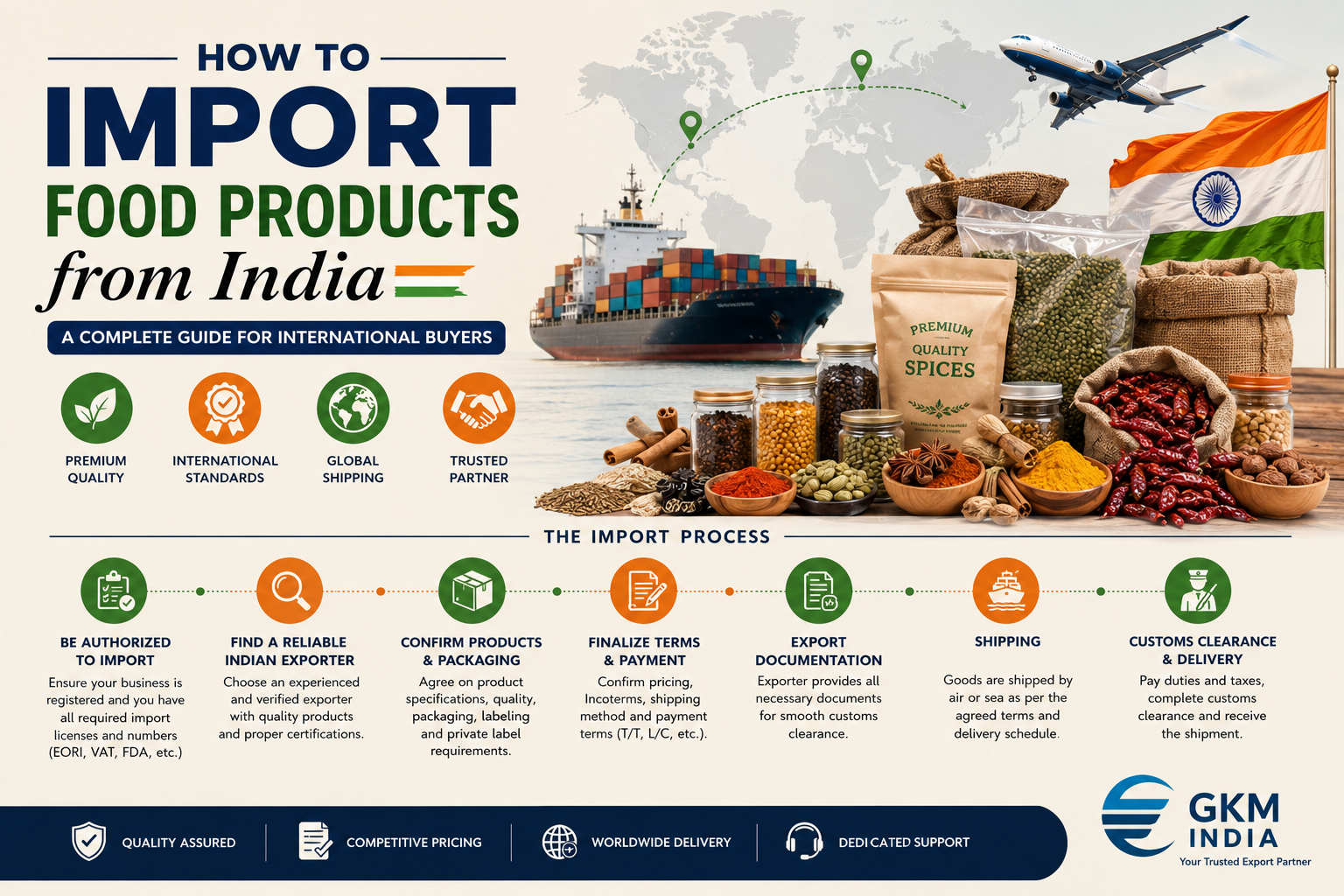
India is one of the world’s largest exporters of agricultural and food products, supplying premium-quality spices, rice, pulses, herbs, dehydrated vegetables, edible seeds, mushrooms, and many other commodities to over 200 countries.
Whether you are a wholesaler, distributor, supermarket chain, food manufacturer, restaurant supplier, or private label brand, importing food products from India can provide access to competitive pricing, consistent quality, and a wide variety of products.
This guide explains the complete process of importing food products from India, including importer registration, documentation, shipping, customs clearance, and country-specific requirements.
Why Import Food Products from India?
India has become one of the preferred sourcing destinations for international buyers because of:
- Large agricultural production
- Wide product variety
- Competitive pricing
- Skilled processing industry
- International quality standards
- Reliable export infrastructure
- Availability of organic products
- Flexible packaging options
- Private label manufacturing
Popular products imported from India include:
- Whole and Ground Spices
- Rice
- Pulses & Lentils
- Herbs
- Herbal Powders
- Dehydrated Vegetables
- Edible Seeds
- Dry Fruits
- Mushrooms
- Flours
- Millets
- Edible Oils
Can Anyone Import Food Products?
Not always.
Most countries require importers to be legally registered before importing commercial food products.
Depending on your country, you may need:
- Import Business Registration
- Customs Registration
- Tax Registration
- Food Business Registration
- Import License (for certain products)
- Health Authority Registration
Always check the latest regulations with your country’s customs and food safety authorities before placing an order.
Import Registration Requirements by Country
Every country has its own regulations. Below are some common requirements.
European Union
Businesses importing food into the European Union generally require:
- EORI (Economic Operators Registration and Identification) Number
- VAT Registration (where applicable)
- Registration as a food business with the relevant national authority
- Compliance with EU food safety regulations
- Proper customs declarations
Organic products sold as organic in the EU must comply with the applicable EU organic regulations and certification requirements.
United Kingdom
Importers generally require:
- UK EORI Number
- Business Registration
- Food Business Registration (where applicable)
- Customs Declaration
- Compliance with UK food safety regulations
United States
Food imports into the United States generally require:
- Business registration
- FDA Food Facility Registration (for facilities that must register under U.S. law)
- Prior Notice submission to the FDA before food shipments arrive
- Compliance with FDA food labeling and safety requirements
- Customs clearance through U.S. Customs and Border Protection (CBP)
Canada
Importers may require:
- Business Number (BN)
- Import/Export Program Account
- Compliance with the Safe Food for Canadians Regulations (SFCR), where applicable
- Canadian Food Inspection Agency (CFIA) requirements
Australia
Importers should ensure compliance with:
- Australian Border Force requirements
- Department of Agriculture, Fisheries and Forestry (DAFF) biosecurity requirements
- Food Standards Australia New Zealand (FSANZ) regulations, where applicable
New Zealand
Requirements generally include:
- Customs registration
- Biosecurity compliance
- Ministry for Primary Industries (MPI) import requirements
- Food safety regulations
United Arab Emirates
Importers typically require:
- Valid Trade License
- Import Code
- Customs Registration
- Municipality approval where required
- Compliance with UAE food labeling requirements
Qatar
Importers generally require:
- Commercial Registration (CR)
- Import License
- Customs registration
- Compliance with Qatar’s food safety and labeling regulations
- Any product registration required by the relevant authorities for specific food categories
Saudi Arabia
Importers generally need:
- Commercial Registration
- Import License (where applicable)
- Compliance with Saudi Food and Drug Authority (SFDA) requirements
- Product labeling in accordance with Saudi regulations
Find a Reliable Indian Exporter
Choosing the right supplier is one of the most important decisions.
A reliable exporter should provide:
- Clear company information
- Valid export registrations
- Product specifications
- Certificates
- Transparent communication
- Professional quotations
- Quality assurance process
- Export experience
Request copies of relevant business registrations and certifications before placing large orders.
Request Product Samples
Before placing a bulk order, ask for product samples.
Evaluate:
- Color
- Aroma
- Taste
- Moisture
- Cleanliness
- Packaging
- Shelf Life
- Product consistency
Testing samples helps avoid costly mistakes later.
Understand Product Specifications
Always agree on detailed specifications, including:
- Grade
- Variety
- Size
- Moisture
- Purity
- Packaging
- Net Weight
- Shelf Life
- Country of Origin
A written specification sheet helps prevent misunderstandings.
Finalize Pricing and Payment Terms
Common international payment methods include:
- Advance Telegraphic Transfer (T/T)
- Letter of Credit (L/C)
- Documents Against Payment (D/P)
- Cash Against Documents (CAD) (subject to agreement)
Discuss these terms:
- Incoterms (EXW, FOB, CFR, CIF, DAP, etc.)
- Delivery timeline
- Insurance
- Freight charges
- Packaging costs
Export Documentation
Depending on the product and destination country, exporters may provide:
- Commercial Invoice
- Packing List
- Bill of Lading / Air Waybill
- Certificate of Origin
- Certificate of Analysis (COA)
- Phytosanitary Certificate (where applicable)
- Fumigation Certificate (where applicable)
- Health Certificate (where applicable)
- Insurance Certificate (for CIF shipments)
- Organic Certificate (if applicable)
- Other documents requested by the importing country
Always verify document requirements with your customs broker or local authorities.
Shipping Methods
Food products are commonly shipped by:
Sea Freight
Ideal for:
- Bulk shipments
- Full Container Loads (FCL)
- Less than Container Loads (LCL)
Air Freight
Suitable for:
- Small orders
- Urgent deliveries
- High-value products
- Product samples
Tips for First-Time Importers
- Verify the exporter’s credentials.
- Request product samples.
- Start with a small trial order.
- Use secure payment methods.
- Clearly define product specifications.
- Confirm packaging and labeling requirements.
- Understand Incoterms before signing a contract.
- Keep copies of all shipping documents.
- Stay updated on your country’s import regulations.
Why Choose GKM INDIA?
At GKM INDIA, we help international buyers source high-quality agricultural and food products from India with confidence.
We offer:
- Premium-quality food products
- Reliable sourcing
- Customized bulk and retail packaging
- Private label solutions
- Export documentation support
- Flexible order quantities
- Professional communication
- Timely shipments
Whether you are an importer, wholesaler, distributor, retailer, or food manufacturer, our team is committed to building long-term business relationships based on quality, transparency, and trust.
Frequently Asked Questions

Say Hey to Mahima, Writer at GKM INDIA. She enjoys writing articles/blogs. When she’s not typing away, you’ll find her buried in books or off on some adventure. Mahima’s all about trying new things and soaking up every experience life throws her way!
- admin

- admin

- admin

- admin